Blank guitar tab paper
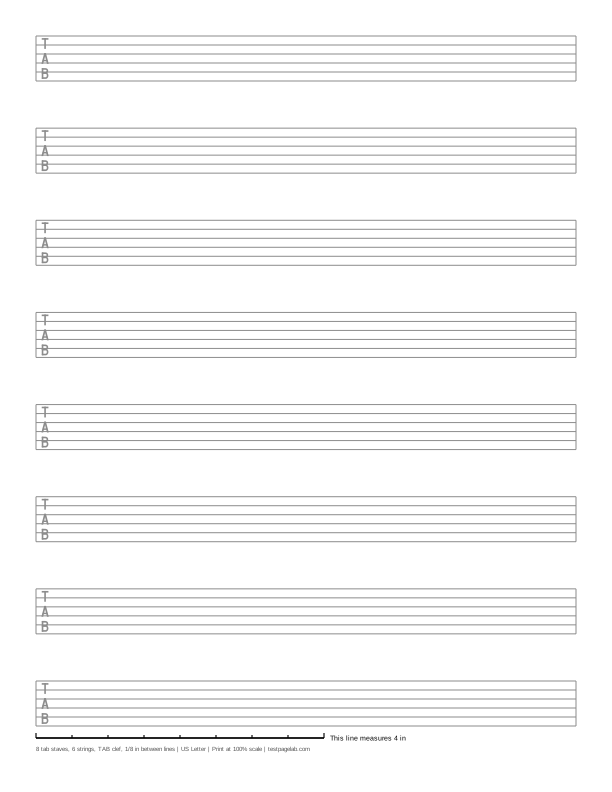
Print at 100%. In the print dialog choose Actual size (or Scale: 100), not Fit to page. Then hold a ruler to the line at the bottom of the sheet.
How to print at actual size, dialog by dialog
- Chrome and Edge: open More settings, find Scale, and pick Actual size if it is listed. If it is not, pick Custom and type 100. Avoid Fit to printable area and Fit to paper.
- Firefox: untick Fit to page width, then set Scale to 100.
- Safari and Preview on a Mac: set Scale to 100%, not Scale to Fit.
- Adobe Acrobat and Reader: under Page Sizing, choose Actual size. The file already asks for it.
- iPhone and iPad: the print sheet has no scale setting. Print, then measure the line.
- Android: this depends on the printer app. Turn off any Fit to page option, then measure the line.
- Any browser: pick the file that matches the paper in your printer. A US Letter file on A4 paper, or the reverse, gets shrunk to fit.
Guitar tab, short for tablature, writes music as fret numbers on lines that stand for the strings. This page prints blank guitar tab paper: 8 tab staves of six lines, each marked TAB at its start, on US Letter or A4. A second sheet has four-line staves for bass guitar and ukulele. Both are free PDFs under the download buttons, and the generator above draws tab for 4 to 7 strings.
Guitar tab paper goes by other names too: tablature paper, blank tab paper, a guitar tab sheet or a guitar tab template. All of them mean staves of string lines with no numbers written on them yet.
Which line is which string
The top line is the highest-pitched string and the bottom line the lowest. On a guitar, the line at the top of the page is the thin high E string, the one nearest the floor as you hold the instrument. A number on a line is the fret to press on that string, and 0 means the string is played open. Numbers stacked one above another are played together, as a chord. In standard tuning the lines read:
| Strings | Instrument | Top to bottom |
|---|---|---|
| 6 | Guitar | e B G D A E |
| 4 | Bass guitar | G D A E |
| 4 | Ukulele | A E C G |
| 5 | Five-string bass | G D A E B |
| 7 | Seven-string guitar | e B G D A E B |
Plain tab does not show how long each note lasts, so write the rhythm above the staff, or write the part out in notes as well, on blank sheet music.
What is on the sheet
The six-string sheet has its lines 1/8 inch apart on US Letter and 3 mm apart on A4, wider than a music staff's, because the fret numbers sit on the lines and two-digit frets need the room. Each tab staff is 5/8 inch tall (15 mm on A4), with about 0.65 inch (20 mm) of paper between staves for chord names, lyrics or counts.
The four-string sheet has the same spacing, so each staff is 3/8 inch (9 mm) tall, and it keeps 8 staves to a page, which leaves almost an inch between them on Letter. Use it as bass tab paper or for blank ukulele tab. The blank guitar tab PDF and the four-string one each come in a Letter and an A4 version.
Other tab layouts
In the generator, Strings sets 4 to 7 lines, and how many tab staves fit depends on it. The most that fit at 1/8 inch on Letter and 3 mm on A4:
| Strings | Staff height | Letter | A4 |
|---|---|---|---|
| 4 | 3/8 in (9 mm) | 13 | 15 |
| 5 | 1/2 in (12 mm) | 10 | 11 |
| 6 | 5/8 in (15 mm) | 8 | 9 |
| 7 | 3/4 in (18 mm) | 6 | 7 |
Bar lines divides every tab staff into 1 to 8 equal measures after the TAB, and landscape gives 6 longer staves at 1/8 inch. Set Clef to None for tab without the letters. For blank bass tab on a five-string bass, set Strings to 5. The grand staff paper page is set up for piano instead, and the staff paper generator explains every setting.
Print it at 100%, then measure
When a print dialog shrinks the page, the tab lines move closer together and fret numbers start to crowd them: 1/8 inch lines printed with Fit to page come out about 0.12 inch apart. Choose Actual size, or Scale 100, before printing. Adobe Acrobat and Reader do that already, as the file asks; in Chrome or Edge, look under More settings. Steps for the other browsers and for phones are in the list under the download buttons.
The line at the bottom
Every sheet ends with a calibration line: 4 inches on the Letter PDF, 10 cm on the A4 one. If it is right, the tab lines are too.
| The 4 in line measures | The 10 cm line measures | A six-string staff | What happened |
|---|---|---|---|
| 4 in | 100 mm | 5/8 in (Letter), 15 mm (A4) | Actual size |
| about 3.89 in | about 97.3 mm | about 0.61 in, or 14.6 mm | Shrunk to fit, or a Letter file on A4 paper |
| about 3.76 in | about 94.1 mm | about 0.59 in, or 14.1 mm | An A4 file on Letter paper |
What this page does not draw
There are no chord diagrams (the small fretboard grids), no rhythm stems, and no music staff paired above each tab staff. Nothing is uploaded, and the page cannot see your printer, so the calibration line is how you check the result.
Frequently asked questions
How do you read guitar tab?
From left to right. Each line is a string, the top one the high E, and each number is the fret to press on it, with 0 for an open string. Numbers in a vertical stack are played together.
Which line is the low E string?
The bottom line. Tab puts the lowest-pitched string at the bottom, so on a six-string guitar the lines read e, B, G, D, A, E from top to bottom.
Can I print bass tab or ukulele tab?
Yes. The four-string sheet works for both: on bass guitar the lines are G, D, A and E from the top, on ukulele A, E, C and G. For a five-string bass, set Strings to 5 in the generator.
Why are tab lines farther apart than staff lines?
Fret numbers are written on the lines rather than between them, and a two-digit fret such as 12 needs more room than a notehead. So tab starts at 1/8 inch (3 mm) where staff paper starts at 1/10 inch (2.5 mm).
Is this tab paper free?
Yes, and there is no account. The sheet is drawn by code in your browser, and the only thing sent anywhere is an anonymous count of page views and downloads, as the privacy page explains.