Coordinate plane graph paper
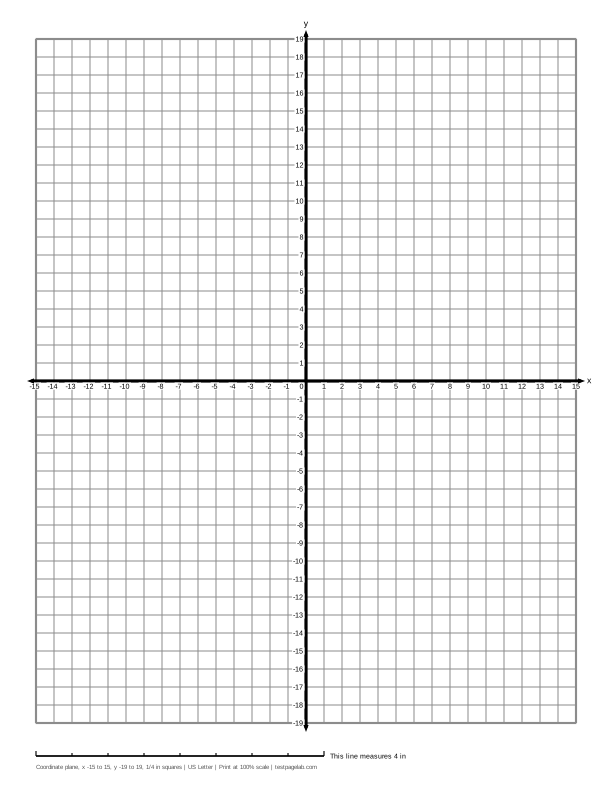
Print at 100%. In the print dialog choose Actual size (or Scale: 100), not Fit to page. Then hold a ruler to the line at the bottom of the sheet.
How to print at actual size, dialog by dialog
- Chrome and Edge: open More settings, find Scale, and pick Actual size if it is listed. If it is not, pick Custom and type 100. Avoid Fit to printable area and Fit to paper.
- Firefox: untick Fit to page width, then set Scale to 100.
- Safari and Preview on a Mac: set Scale to 100%, not Scale to Fit.
- Adobe Acrobat and Reader: under Page Sizing, choose Actual size. The file already asks for it.
- iPhone and iPad: the print sheet has no scale setting. Print, then measure the line.
- Android: this depends on the printer app. Turn off any Fit to page option, then measure the line.
- Any browser: pick the file that matches the paper in your printer. A US Letter file on A4 paper, or the reverse, gets shrunk to fit.
Printable coordinate plane graph paper: a grid of squares with the x axis and the y axis drawn across it in black, each ending in arrowheads and numbered along its length. The page starts from a whole sheet of it. On US Letter that is 30 by 38 squares of 1/4 inch, with the axes crossing in the middle, the x axis numbered from -15 to 15 and the y axis from -19 to 19. On A4 it is 36 by 52 squares of 5 mm, numbered from -18 to 18 and from -26 to 26.
This is the graph paper with x and y axis that math classes use to plot points and graph lines on a coordinate grid. It also goes by coordinate graph paper, coordinate grid paper, 4 quadrant graph paper, numbered graph paper or graph paper with numbers, and Cartesian graph paper, after Descartes, who gave the two axes their place. Every setting above can be changed; the ready-made PDFs under the download buttons come from the same settings.
Four quadrants or the first
The two axes divide the plane into four quadrants. With All four, the axes cross in the middle of the grid, so x and y run from negative numbers on one side to positive ones on the other. With First only, the grid holds the first quadrant alone, where both x and y are 0 or more: the axes become the grid's left and bottom edges, the numbers sit outside it, and the corner is 0.
First quadrant graph paper is what early grades plot on, and what charts of time or distance need, since neither goes below zero. Four quadrants come in once negative numbers do.
The axes and the numbers
The axes are drawn heavier than any grid line and in black, whatever color the grid is. Each runs a little past the grid to an arrowhead, and the letters x and y sit beyond the arrowheads. The axes always fall on a grid line, so every number names a line and every point with whole-number coordinates sits on a crossing.
The numbers are set at 40% of a square's side, from 5 to 8 points. Each one sits on a white patch cut out of the grid lines, so no line runs through a digit, and a negative number keeps its figures centered under its line with the minus sign to the left, the way math books set them. When the squares are too small for a number at every line, the sheet numbers every second line, or every fifth, and never prints a number it has no room for. To number the axes yourself, untick Number the axes: the axes, arrowheads and letters stay.
Axes run to sets the last number on each axis. Fill the space numbers as far as the squares reach, and 10 gives a plane from -10 to 10, which at 1/4 inch is 5 inches across. If the squares are too big for the number you choose, the generator says how far the axes reach.
One plane or several on a page
Planes on a page sets out 1, 2, 4 or 6 coordinate planes, each with its own axes and numbers: two one above the other, four and six two across. With more than one, each plane is square, and if the squares are too big for that many, the generator draws fewer and says so.
The ready-made sheets
Beside the whole sheet, under the download buttons:
- Axes -10 to 10. One plane of 20 by 20 squares, the classic coordinate plane. On US Letter the squares are 1/3 inch and the plane is 6 2/3 inches across; on A4 they are 8 mm and the plane is 16 cm.
- 4 per page. Four planes from -10 to 10, each 20 by 20 squares, numbered every second line. On US Letter the squares are 1/8 inch, so each plane is 2.5 inches across; on A4 they are 3 mm and each plane is 6 cm.
- First quadrant. The whole sheet in the first quadrant: 0 to 30 by 0 to 38 on US Letter at 1/4 inch, 0 to 37 by 0 to 53 on A4 at 5 mm.
Print it at 100%
For a square to be the size you chose, the page must not be scaled. In Chrome and Edge, open More settings and set Scale to Actual size, or to Custom and 100. In Safari or Preview set Scale to 100%. Turn off Fit to page anywhere you see it. The dialog-by-dialog list is under the download buttons. Print the Letter file on Letter paper and the A4 file on A4.
A sheet shrunk by a few percent still looks right, because the squares stay square and the numbers still line up, but a length measured on it with a ruler will be off.
Check it with the line
The line at the bottom of the sheet is exactly 4 inches long on inch sheets and exactly 10 cm long on metric sheets.
| The 4 in line measures | The 10 cm line measures | What happened |
|---|---|---|
| 4 in, within about 1/32 in | 100 mm, within about 0.5 mm | Printed at actual size. |
| about 3 7/8 in (3.89 in) | about 97.3 mm | A US Letter file was shrunk to fit A4 paper. |
| about 3 3/4 in (3.76 in) | about 94.1 mm | An A4 file was shrunk to fit US Letter paper. |
| about 3.8 to 3.9 in | about 95 to 97 mm | Fit to printable area or Fit to page was on. |
| about 4 1/16 to 4 1/8 in | about 102 to 103 mm | Borderless printing enlarged the page. |
On a 1/4 inch sheet, 16 squares span the 4 inch line. On a 5 mm sheet, 20 squares span the 10 cm line.
Other sheets
The same generator draws plain graph paper in any size, including 1/4 inch, 1/2 inch, 1 inch, 1 cm and 5 mm, and isometric graph paper and dot grid paper. It does not draw polar or log graph paper; incompetech's generators do.
Frequently asked questions
What is coordinate plane graph paper?
Graph paper with an x axis and a y axis drawn across the grid and numbered, so you can plot a point from its coordinates without drawing the axes first. The x axis runs left to right and the y axis up and down; where they cross is the origin, 0.
How do I print a coordinate plane from -10 to 10?
Set Axes run to 10, or use the Axes -10 to 10 sheet under the download buttons: one plane of 20 by 20 squares, 1/3 inch on US Letter and 8 mm on A4.
Can I print several coordinate planes on one page?
Yes. Set Planes on a page to 2, 4 or 6, or use the 4 per page sheet under the download buttons, which has four planes from -10 to 10.
What is the first quadrant?
The quarter of the plane where x and y are both positive: right of the y axis and above the x axis. Choose First only and the grid is that quadrant alone, with the axes along its left and bottom edges and the numbers starting from 0.
Can I print it without the numbers?
Yes. Untick Number the axes. The axes, their arrowheads and the letters x and y stay, so you can write in your own scale, such as 5s or 10s.