1 cm graph paper
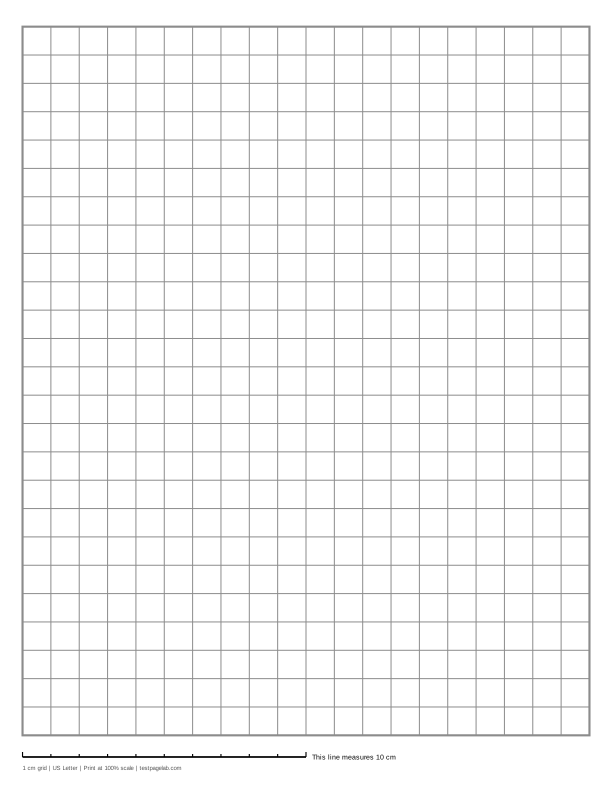
Print at 100%. In the print dialog choose Actual size (or Scale: 100), not Fit to page. Then hold a ruler to the line at the bottom of the sheet.
How to print at actual size, dialog by dialog
- Chrome and Edge: open More settings, find Scale, and pick Actual size if it is listed. If it is not, pick Custom and type 100. Avoid Fit to printable area and Fit to paper.
- Firefox: untick Fit to page width, then set Scale to 100.
- Safari and Preview on a Mac: set Scale to 100%, not Scale to Fit.
- Adobe Acrobat and Reader: under Page Sizing, choose Actual size. The file already asks for it.
- iPhone and iPad: the print sheet has no scale setting. Print, then measure the line.
- Android: this depends on the printer app. Turn off any Fit to page option, then measure the line.
- Any browser: pick the file that matches the paper in your printer. A US Letter file on A4 paper, or the reverse, gets shrunk to fit.
Printable 1 cm graph paper: squares one centimeter on a side, large enough to write a number in each one. On US Letter the sheet is 20 squares across and 25 down, a grid 20 by 25 cm. On A4 it is 19 by 27 squares, 19 by 27 cm.
There is no heavier line by default, because every square is already a round number: ten squares make 10 cm, and the line at the bottom of the sheet is exactly that long. If you want a darker line every 5 cm, set Heavier line to every 5 lines.
Centimeter squares, in numbers
One square is 10 mm on a side, about 0.39 inch. That is a little more than one and a half times the width of a 1/4 inch square, which makes this the grid to use when the squares have to be written in rather than just counted. It is sometimes called centimeter grid paper or 1 cm grid paper; all three names mean the same sheet.
The grid is centered with 6 mm margins at the sides and a strip at the bottom for the calibration line. On US Letter that leaves room for 20 whole centimeters across and 25 down, 500 squares. On A4, 19 across and 27 down, 513 squares. A4 is narrower and taller than Letter, which is why the counts swap direction.
Uses in math
- Area and perimeter. Shapes drawn along the lines have areas you can count in square centimeters and edges you can count in centimeters, with no conversion.
- Centimeter cubes. The plastic unit cubes used in many classrooms are 1 cm on a side, so on a sheet printed at actual size each cube covers exactly one square. That lines up arrays, towers and bar models with the grid.
- Bar graphs and pictographs. One square per unit keeps a small data set readable without a ruler.
- Coordinate planes. A plane from -9 to 9 on both axes fits on one sheet with room for labels, and each point lands in a square large enough to mark clearly.
- Arrays for multiplication. A 7 by 8 rectangle of centimeter squares is big enough to shade in rows and count.
Print it at 100%
For the squares to be centimeters, the print dialog must leave the page alone. In Chrome and Edge, open More settings and set Scale to Actual size, or to Custom and 100. In Safari or Preview set Scale to 100%. Turn off Fit to page anywhere you see it. The steps for every browser are listed under the download buttons.
Use the file that matches the paper in the tray. An A4 file printed on US Letter paper is shrunk to fit by most printers, and centimeter cubes will stop fitting the squares.
Check it with the line
The line at the bottom of the sheet is exactly 10 cm long, with a tick every centimeter. Measure it with a ruler. Ten squares should cover it exactly, so you can also lay the ruler along any row of the grid.
| The 10 cm line measures | One square measures | What happened |
|---|---|---|
| 100 mm, within about 0.5 mm | 10 mm | Printed at actual size. |
| about 97.3 mm | about 9.7 mm | A US Letter file was shrunk to fit A4 paper. |
| about 94.1 mm | about 9.4 mm | An A4 file was shrunk to fit US Letter paper. |
| about 95 to 97 mm | about 9.5 to 9.7 mm | Fit to printable area or Fit to page was on. |
| about 102 to 103 mm | about 10.2 mm | Borderless printing enlarged the page. |
A square of 9.4 mm is hard to see by eye. A centimeter cube shows it at once: it overhangs the square on two sides.
Other sizes
For smaller squares, 5 mm graph paper fits two to the centimeter. The same generator draws 1/4 inch graph paper, isometric graph paper and dot grid paper, and any other size on the main graph paper page.
Frequently asked questions
How big is a square on centimeter graph paper?
One centimeter on each side, which is 10 mm or about 0.39 inch. The whole grid is 20 by 25 cm on US Letter and 19 by 27 cm on A4.
How many squares are on a sheet?
On US Letter, 20 across and 25 down, 500 squares. On A4, 19 across and 27 down, 513 squares. Changing the margins can add or remove a row or a column.
Will centimeter cubes fit the squares?
Yes, when the sheet is printed at actual size. Measure the 10 cm line at the bottom first: if it measures 100 mm, the cubes will sit squarely on the grid. If it is shorter, the page was scaled down when it printed.
Can I add a darker line every 5 cm?
Yes. Set Heavier line to every 5 lines. The grid then stops on a whole 5 cm block, which on US Letter gives 20 by 25 squares and on A4 15 by 25.
What is the difference between 1 cm and 5 mm graph paper?
Only the size of the square: 5 mm paper has four squares where 1 cm paper has one. Use 1 cm when each square has to hold a number or a cube, and 5 mm for drawing, plotting and writing.